
If you’ve been arrested for DWI in Texas, you are facing two separate legal cases:
Many people focus only on the criminal case — but your ALR hearing may be the most important step in protecting your ability to drive.
Call Clyde W. Burleson Now:
Free, Confidential Consultation — Available Now
An ALR Hearing is a civil proceeding handled by the Texas Department of Public Safety (DPS). Its purpose is to determine whether your driver’s license will be suspended after a DWI arrest.
This hearing is completely separate from your criminal DWI case.
If you do nothing, your license will be automatically suspended.
After a DWI arrest, law enforcement will:
Confiscate your driver’s license
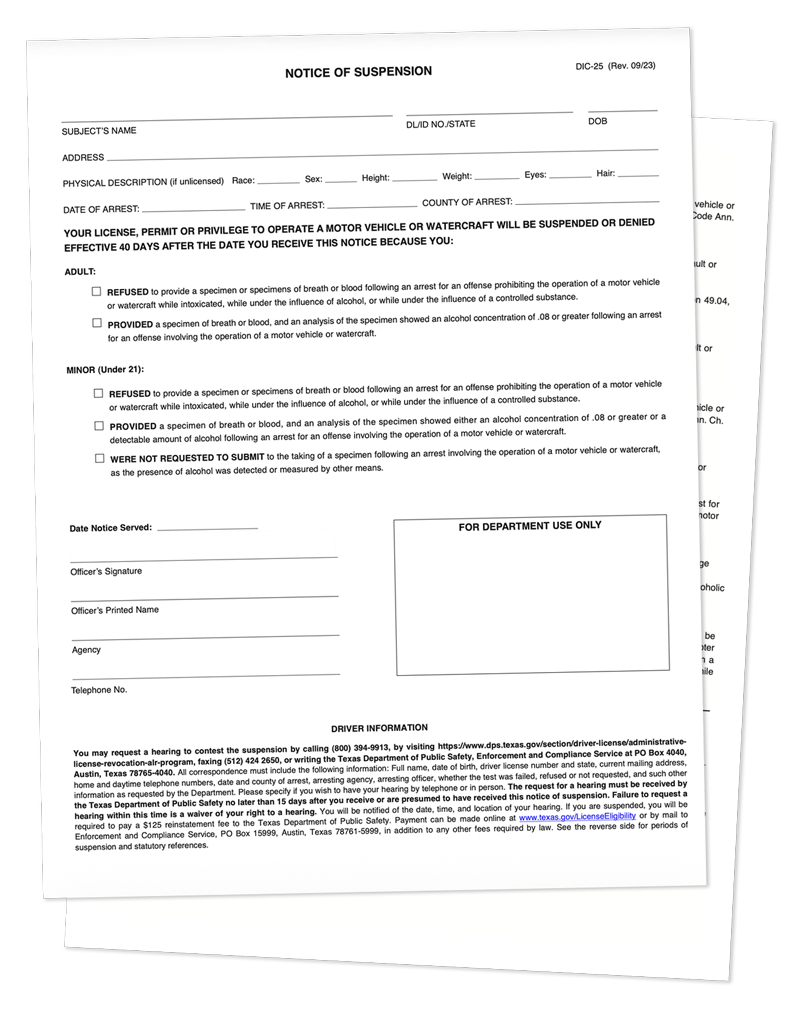
Issue a DIC-25 Notice of Suspension and Temporary Driving Permit
At the top of the form, it states:
“Your License, Permit or Privilege to Operate a Motor Vehicle or Watercraft Will Be Suspended or Denied Effective 40 Days after the Date You Receive This Notice.”
This language makes suspension sound automatic — but it is not.
At the bottom of the notice, it explains:
You may request a hearing to contest the suspension. The request must be received by the Texas Department of Public Safety no later than 15 days after you receive notice. Failure to request a hearing waives your right to a hearing.
If you do not request an ALR hearing within 15 days:
Your license suspension begins automatically
Suspension takes effect 40 days after notice
You lose your right to challenge it
An ALR hearing can directly impact:
Unlike many criminal proceedings, the ALR hearing allows your attorney to:
This testimony is often given without preparation from a district attorney — and inconsistencies can significantly help your defense.
If an officer:
Your attorney can use that sworn testimony to challenge the criminal DWI case.
In many cases, mistakes made during an ALR hearing have led to DWI dismissals.
Yes. If you lose the ALR hearing, you may file an appeal (for a fee). An appeal can delay the suspension from going into effect while the case is reviewed.
Successfully defending an ALR hearing requires strategic legal representation from a Houston DWI lawyer experienced in ALR defense.
You must request the hearing within 15 days of arrest.
If requested:
The hearing is conducted before a judge at the State Office of Administrative Hearings (SOAH).
You may attend in person or remotely.
However, attending in person is strongly recommended.
If your attorney subpoenas the arresting officer and the officer fails to appear, you may win by default.
Remote hearings may limit your ability to challenge live testimony and gather valuable evidence.
Your defense strategy may include:
Show that your ability to drive is essential for:
Demonstrate corrective action such as:
An officer must have reasonable suspicion to initiate a traffic stop. If not, the stop was unlawful.
An officer must have specific articulable facts to justify arrest.
Possible challenges include:
If the officer failed to properly read the statutory warning before requesting a breath or blood test, you may win the ALR hearing.
Your attorney can request:
If DPS fails to produce records after payment, the breath test may be excluded from evidence.